Table of contents13 sections
- Sea freight or air freight: which lane fits your shipment
- How sea freight is priced: CBM, LCL, and FCL explained
- How air freight is priced: chargeable weight and volumetric weight
- The China to Dubai lane: transit time and what drives it
- What 499 AED per CBM and 35 AED per kg actually cover
- Consolidation and LCL: how small sellers ship without a full container
- Jebel Ali and customs clearance on the inbound leg
- Building landed cost: freight plus duty, VAT, and last-mile
- From port to customer: storage, fulfilment, and last-mile in the UAE
- A worked example: costing a CBM of goods from China to a Dubai customer
- When to switch lanes: thresholds for moving from air to sea and back
- Frequently Asked Questions
- References
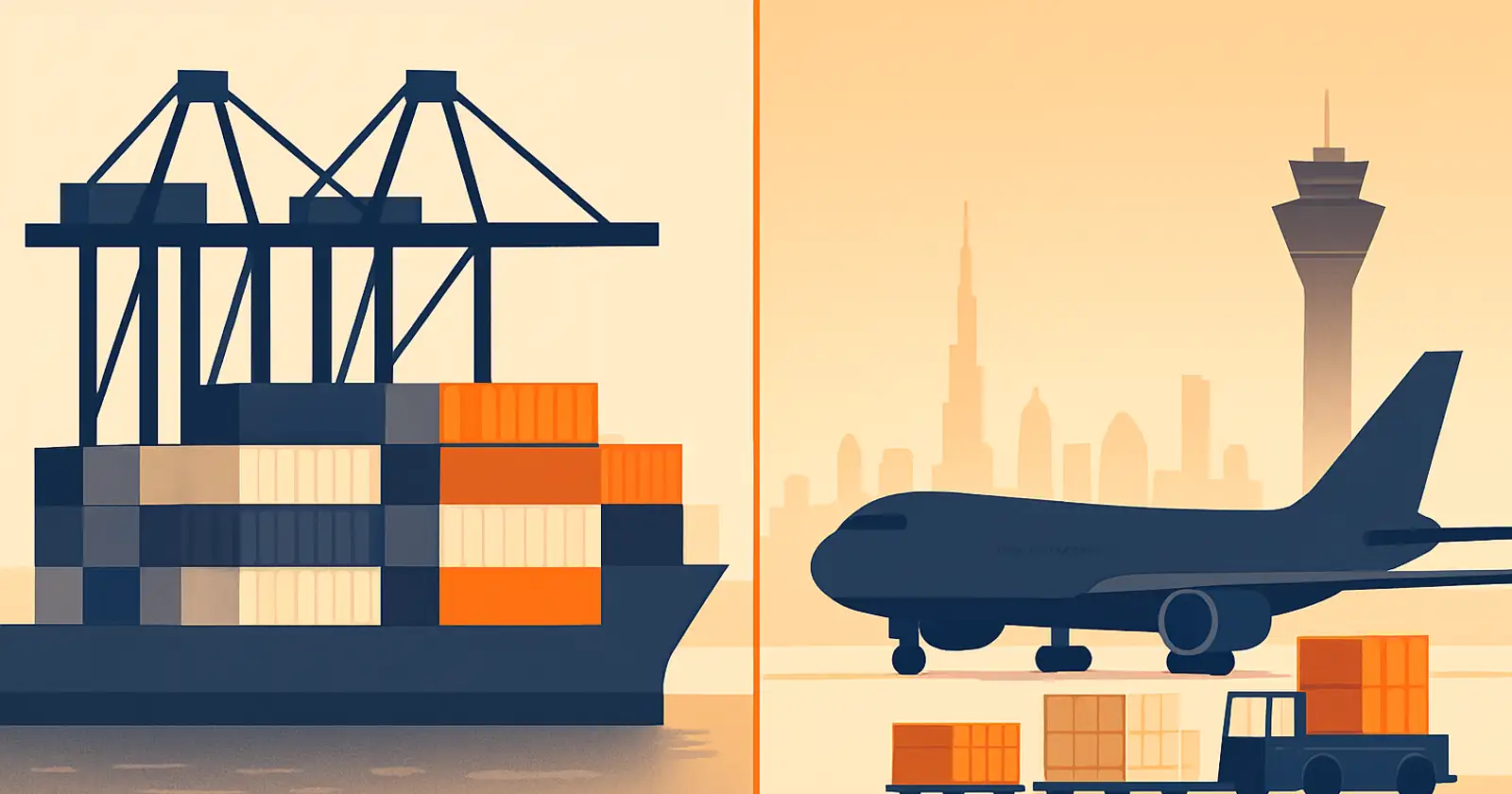
Quick answer: Most freight that Russian-speaking sellers route to Dubai moves on one of two lanes, sea or air, and the choice turns on density, urgency, and order value rather than preference. Sea freight is the default for stock replenishment because it is priced per cubic metre and rewards volume. SamVertex moves China-to-UAE consolidated sea freight at AED 499 per CBM, excluding import duty, VAT, and last-mile. Air freight is priced per kilogram of chargeable weight, the greater of actual and volumetric, at AED 35 per kg, and wins only for light, high-value, or time-critical goods. The rule is simple: if your shipment is dense and not urgent, ship LCL or FCL by sea through Jebel Ali; if it is light, urgent, or low-volume, fly it. Consolidation lets small sellers share a container and pay only for the space they use, which is why per-CBM pricing matters more than headline container rates for most stores building UAE inventory.
This guide is for sellers building inventory in the UAE from Chinese suppliers, the common path for stores selling on Amazon, Noon, and their own sites. It lays out the whole decision space: how each lane is priced, what the China-to-Dubai transit really looks like, where customs bites at Jebel Ali, and how to stack freight into a true landed cost. Every SamVertex figure here is the published rate, not an estimate. We move both lanes ourselves through sea freight from China to the UAE and air freight from China to the UAE, so the numbers below are the ones we quote, not market averages.
Sea freight or air freight: which lane fits your shipment
Three variables decide the lane, and only three: density, urgency, and order value. Everything else is detail.
Density is the relationship between weight and volume. Sea freight charges by volume (the cubic metre), so dense cargo (heavy for its size) is cheap to ship by sea and the volume you pay for is small. Air freight charges by chargeable weight, so light cargo that fills a lot of space (bulky-light) is punished, because its volumetric weight runs ahead of what it actually weighs on a scale.
Urgency is whether the timeline can absorb a sea sailing. A sea shipment on the China-Dubai lane is measured in weeks, an air shipment in days. If a launch date, a restock deadline, or an out-of-stock listing cannot wait, that pressure alone can justify the air premium regardless of the math.
Order value is the freight cost as a share of the goods. AED 35 per kg of air freight is trivial against a kilo of high-value electronics and ruinous against a kilo of low-value homeware. The higher the value packed into each kilo, the more air freight earns its place.
The plain rule that falls out of those three:
| If your shipment is | Ship it by | Why |
|---|---|---|
| Dense and not urgent | Sea (LCL or FCL) | Volume pricing rewards density; weeks of transit are acceptable |
| Light, high value, urgent | Air | Chargeable weight stays low; the premium is small against the goods |
| Low volume, not urgent | Sea (LCL) | Consolidation lets you pay per CBM, not for a whole container |
| Bulky and light | Sea | Volumetric weight makes air freight punishing |
Most replenishment stock lands in the first or third row, which is why sea is the default and air is the exception you reach for deliberately. The rest of this guide quantifies each of those rows.
How sea freight is priced: CBM, LCL, and FCL explained
Sea freight for sellers turns on three terms. Get these right and the cost stops being a mystery.
CBM is the cubic metre, one metre by one metre by one metre of space. It is the unit that governs sea pricing. You are billed for the space your goods occupy, full stop. A dense pallet and a bulky-light pallet of the same volume cost the same to ship by sea even though one weighs far more, because sea freight sells space, not mass.
LCL means less than container load. Your cargo shares a container with other shippers' cargo, and each shipper pays only for the CBM they use. This is consolidation, and it is how a seller moving three or five cubic metres ships at all without renting a whole 33 CBM box.
FCL means full container load: a dedicated container for one shipper. You pay for the container whether you fill it or not, so FCL only makes sense once your volume is large enough that the per-CBM cost of a full container drops below the LCL rate.
The practical consequence is that for most growing stores, the number that governs cost is the per-CBM rate, not the headline price of a container. SamVertex prices consolidated sea freight at AED 499 per CBM on the China-to-UAE lane. That is the figure you multiply by your volume, and it is the figure that decides whether sea beats air for a given shipment. We cover the mechanics in depth in our sea freight China to UAE guide.

How air freight is priced: chargeable weight and volumetric weight
Air freight does not bill the weight on the scale. It bills chargeable weight, defined as the greater of actual weight and volumetric weight.
Actual weight is what the shipment weighs. Volumetric weight converts the space it occupies into a notional weight using an industry divisor, so a large, light box is treated as if it weighed more than it does. The carrier compares the two and charges whichever is larger.
This is why density decides the air bill. A shipment of dense goods will be charged on its actual weight, because that exceeds its volumetric weight. A shipment of bulky-light goods (pillows, plastic housewares, anything that fills a box without filling the scale) will be charged on its volumetric weight, which can be several times the actual weight. The same box of light goods that costs little to ship by volume on the sea lane costs a punishing amount to fly, because air converts that volume into chargeable kilos.
The takeaway: before you quote air freight, ask what drives the chargeable weight. If it is actual weight, the cargo is dense and air is at least worth costing. If it is volumetric weight, the cargo is bulky-light and almost certainly belongs on sea. SamVertex air freight is AED 35 per kg of chargeable weight on the China-to-UAE lane, and the air freight China to UAE when-to-use guide works through the cases where it pays off.
The China to Dubai lane: transit time and what drives it
Transit time on this lane is not a single number, it is a range driven by variables you can partly control. Sea runs in weeks, air in days, and the gap between them is the whole reason urgency is one of the three deciding variables.
| Lane | Transit character | Main drivers |
|---|---|---|
| Sea (LCL) | Weeks; longest of the two | Consolidation cut-off, sailing schedule, customs clearance |
| Sea (FCL) | Weeks; slightly faster than LCL at origin | Sailing schedule, customs clearance |
| Air | Days | Flight availability, customs clearance |
The variable that surprises new importers is the consolidation cut-off. An LCL shipment does not sail when your cargo is ready; it sails when the consolidated container is closed and the vessel departs. Miss the cut-off and your goods wait for the next sailing, which can add days before the clock even starts. The sailing schedule is the next driver: vessels on this lane leave on a fixed rhythm, not on demand, so the calendar, not your readiness, sets the departure.
The third driver, customs clearance at Jebel Ali, applies to both lanes and is covered in its own section below. The fourth, easy to miss, is the advance manifest window: under the UAE's No Manifest, No Load rule, shipping instructions must clear a 72-hour pre-departure window or the cargo is rolled to the next vessel, returned to origin, or diverted at the shipper's cost. That window is a deadline on paperwork, not on cargo, and it is why pre-staging manifest data is part of the transit plan, not an afterthought.
Plan your timeline around the cut-off and the 72-hour window, not just the headline sailing days. Two shipments on the same vessel can have very different door-to-door times depending on whether they made the cut-off cleanly.
What 499 AED per CBM and 35 AED per kg actually cover
Both freight rates cover the move, and only the move. This matters enormously for landed cost, because the headline freight figure is never the whole bill.
| Rate | Amount | Unit | Covers | Excludes |
|---|---|---|---|---|
| Sea freight, China to UAE | AED 499 | per CBM | Consolidated sea move, China to UAE | Import duty, VAT, last-mile |
| Air freight, China to UAE | AED 35 | per kg chargeable | Air move, China to UAE | Import duty, VAT, last-mile |
What sits on top of freight, every time:
- Import duty. The UAE standard customs duty is 5% of the CIF value (cost, insurance, and freight) for most goods, under the GCC unified tariff. Some categories differ, but 5% is the baseline you should model.
- VAT. Import VAT is 5% on the value of the goods including duty. For a VAT-registered seller it is recoverable as input tax, but it is still cash out at import.
- Last-mile and fulfilment. Getting the goods from the port into a warehouse, picked, packed, and to the customer is a separate cost stack, covered later in this guide.
So the freight rate is the first line of the landed cost, not the landed cost itself. Anyone setting a selling price off the freight figure alone is underpricing their own goods. For the import paperwork side, our UAE customs clearance service handles the declaration; the duty and VAT mechanics are in our customs clearance for ecommerce guide.
Consolidation and LCL: how small sellers ship without a full container
Consolidation is the single mechanism that lets a small store import economically. Without it, a seller's only options would be to rent a whole container (FCL) for cargo that fills a fraction of it, or to fly everything at air rates. Both are wrong for low volume.
LCL consolidation solves this by pooling several shippers' cargo into one container. Each shipper pays per CBM for the space they use and nothing for the space they don't. A seller with four cubic metres pays for four cubic metres at AED 499 each, regardless of how much of the physical container their goods occupy relative to others.
The question every growing seller eventually asks is when to graduate from LCL to FCL. The answer is volume. A standard 20-foot container holds roughly 33 CBM of usable space and a 40-foot container roughly 67 CBM. As long as your shipment volume sits well below the point where a full container's flat cost divided by your CBM beats the LCL per-CBM rate, LCL is cheaper and you should not wait to fill a box you cannot fill. The moment your recurring volume approaches a full container, FCL's per-CBM cost drops below the LCL rate and the switch pays for itself.
The rule of thumb: ship LCL while your volume is small and growing, and do not hold inventory back from sale just to fill an FCL. Holding stock to fill a container costs you stockouts and storage; paying per CBM costs you the per-CBM rate. The second is almost always the cheaper mistake to avoid.
Jebel Ali and customs clearance on the inbound leg
Sea freight from China lands at Jebel Ali, the main sea entry point for Dubai and the wider region, and the gateway to the Jebel Ali Free Zone (JAFZA). Where your goods are cleared and stored after they land changes their customs and VAT treatment, so this is a decision, not a default.
Free zone routing. Goods held inside a free zone such as JAFZA are, broadly, treated as outside the UAE customs territory until they enter the local market. That can defer import duty and VAT for stock that is re-exported or held in bond, which suits sellers who import in bulk and ship to multiple markets.
Mainland routing. Goods cleared into the mainland are imported for domestic sale, so duty and VAT are due on entry. This is the straightforward path for a seller whose stock is destined for UAE customers and a UAE fulfilment centre.
The choice is not abstract; it determines when you pay duty and VAT and whether you pay them at all on goods you re-export. A seller building UAE inventory for UAE customers usually clears to the mainland and pays on entry. A seller using the UAE as a regional hub may benefit from free zone bond.
Two rules bite on this leg regardless of routing. The first is the 72-hour advance manifest window described above: the No Manifest, No Load rule means the manifest data has to be filed and approved before the vessel loads at the compliance port, or the cargo does not move. The second is the clearance itself, which has to be done correctly the first time, because a misdeclared HS code or a missing document holds the goods. The process from arrival to release runs as follows:
Getting the declaration right is what our UAE customs clearance service exists to do; for sellers importing electronics specifically, the ECAS certification rules add a layer worth reading before you ship.
Building landed cost: freight plus duty, VAT, and last-mile
Landed cost is the figure you actually price against, and it is a stack, not a single line. Build it in order and nothing surprises you at the port.
| Cost component | Basis | Notes |
|---|---|---|
| Goods (ex-works) | Supplier invoice | The cost of the product itself |
| Freight | AED 499 per CBM (sea) or AED 35 per kg (air) | The move only |
| Customs duty | 5% of CIF | Cost + insurance + freight, GCC standard rate |
| Import VAT | 5% of (goods + duty) | Recoverable for VAT-registered sellers, but cash out at import |
| Inbound to warehouse | Per shipment | Port to fulfilment centre |
| Storage | AED 85 per CBM/month (dry) | Held until sold |
| Fulfilment | AED 3 per order (marketplace) | Pick and pack |
| Last-mile | AED 29 per order (direct-to-consumer) | Pick-pack plus delivery |
The discipline is to carry every line down to a per-unit number before you set a price. Freight per CBM divided by units per CBM gives freight per unit. Duty and VAT are percentages of value, so they scale with the goods. Storage is per CBM per month, so it scales with how long stock sits. Fulfilment and last-mile are per order, so they scale with sales velocity, not volume. A seller who models only freight and goods is missing roughly a fifth of their true cost on a typical shipment, and that fifth is the difference between a margin and a loss.
From port to customer: storage, fulfilment, and last-mile in the UAE
Freight is one link in a chain that ends at the customer's door. The downstream stack carries its own first-party figures, and they are where per-order economics live.
| Service | Rate | Unit |
|---|---|---|
| Dry storage | AED 85 | per CBM per month |
| Climate-controlled storage | AED 120 | per CBM per month |
| Pick and pack (marketplace) | AED 3 | per order up to 20kg |
| Direct sales full delivery (last mile) | AED 29 | per order |
| FBA and Noon FC prep | AED 0.5 | per unit |
| Re-delivery (second attempt) | AED 15 | per order |
| COD collection | AED 0 | per order |
| Returns processing | AED 0 | per order |
A few of these change the unit economics more than their size suggests. Storage is per CBM per month, so it rewards inventory that turns fast; the same CBM that costs AED 499 to ship costs AED 85 a month to sit still, and slow stock quietly eats margin. Re-delivery at AED 15 is the cost of a failed first attempt, which is why accurate addresses and customer contact matter to your bottom line. COD collection and returns processing are free, and settlement runs every Monday, which matters in a market where cash on delivery is still common.
How the goods sell decides which downstream rates apply. Marketplace orders flow through marketplace fulfilment at AED 3 per order; goods you send into Amazon FBA or Noon FC go through FBA prep at AED 0.5 per unit; direct-to-consumer sales use direct-to-consumer fulfilment at AED 29 per order all-in. The full operation, port to customer, is what end-to-end 3PL in Dubai covers, and there are no setup fees, no monthly minimum, and no lock-in contract on any of it.
A worked example: costing a CBM of goods from China to a Dubai customer
Numbers make the decision frame concrete. Take one cubic metre of goods imported by sea, sold direct to UAE customers. Assume the CBM holds 200 retail units, the goods are worth AED 10,000 ex-works, and the stock turns in one month.
| Line | Calculation | Cost |
|---|---|---|
| Goods (ex-works) | Given | AED 10,000 |
| Sea freight | 1 CBM x AED 499 | AED 499 |
| Customs duty | 5% of (10,000 + 499) | AED 525 |
| Import VAT | 5% of (10,000 + 525) | AED 526 |
| Storage (1 month, dry) | 1 CBM x AED 85 | AED 85 |
| Fulfilment + last-mile | 200 orders x AED 29 | AED 5,800 |
| Total landed + delivered | AED 17,435 | |
| Per unit | 17,435 / 200 | AED 87.18 |
The lesson is in the proportions. Freight is AED 499, a small slice of an AED 17,435 total. Duty and VAT together add about AED 1,051. The dominant downstream cost is last-mile at AED 5,800, because it is charged per order and there are 200 of them. A seller obsessing over the freight line while ignoring per-order delivery is optimising the wrong number.
Now swap the lane. If the same CBM weighs, say, 250 kg, air freight at AED 35 per kg would cost AED 8,750 against sea's AED 499. That single substitution adds more than AED 41 per unit. Air earns that premium only when the goods are valuable enough per kilo that the customer pays for speed, or when being in stock now is worth more than the margin the air rate consumes. For ordinary replenishment stock, sea is not close.
When to switch lanes: thresholds for moving from air to sea and back
The lane choice is not a one-time decision; it is a per-shipment classification you can do quickly with a few rules of thumb.
Switch to air when density is low and value is high. If chargeable weight is driven by actual weight (dense cargo) and the goods carry high value per kilo, air's AED 35 per kg is a small share of the unit cost and the speed is a free bonus. Pharmaceuticals, small electronics, and high-margin accessories often clear this bar.
Stay on sea when cargo is bulky-light. The moment volumetric weight exceeds actual weight, air punishes you for the space, and the more the box outweighs the scale, the worse it gets. Bulky-light goods belong on the volume-priced sea lane almost without exception.
Use urgency as an override, not a default. A sea sailing you can plan around is always cheaper. Air is the lever you pull when a launch, a stockout, or a deadline makes weeks of transit impossible. Pulling it routinely turns a freight line into a margin problem.
Use volume to choose within sea. Below a full container's worth, ship LCL and pay per CBM. As recurring volume approaches a container, move to FCL and let the flat container cost beat the per-CBM rate. Do not hold stock back from sale to fill a box.
| Trigger | Move to | Reason |
|---|---|---|
| High value per kg, dense | Air | Premium is small against the goods, speed is free |
| Volumetric > actual weight | Sea | Air penalises bulky-light cargo |
| Hard deadline, stockout | Air (override) | Speed outweighs the rate |
| Volume near full container | FCL sea | Flat container cost beats per-CBM rate |
| Low and growing volume | LCL sea | Pay only for the space used |
Classify each shipment against these and the lane chooses itself. When you want a quote on either lane or want the whole chain handled from the Chinese factory to the UAE customer, contact SamVertex and we will cost it against your actual CBM and order profile.
Frequently Asked Questions
Is sea freight or air freight cheaper from China to Dubai?
Sea is cheaper for almost all stock replenishment because it is priced per cubic metre and rewards volume. Air only wins for light, high-value, or urgent goods, since it is billed on chargeable weight. SamVertex prices sea at AED 499 per CBM and air at AED 35 per kg chargeable, both excluding duty, VAT, and last-mile.
What is CBM in freight?
CBM is cubic metre, the unit of volume that governs sea LCL pricing. You are billed for the space your goods occupy, so a dense pallet and a bulky-light one of the same volume cost the same to ship by sea even if they weigh differently.
What is the difference between LCL and FCL?
LCL (less than container load) consolidates several sellers' cargo into one shared container, so each pays only for the space used. FCL (full container load) is a dedicated container for one shipper. Small and growing stores usually start with LCL and move to FCL once they can fill a container.
How long does sea freight take from China to Dubai?
Sea transit on the China-Dubai lane runs longer than air and depends on the consolidation cut-off, the sailing schedule, and customs clearance at Jebel Ali. Air is the option when the timeline cannot absorb a sea sailing. Plan around the cut-off and the 72-hour advance manifest window, not just the sailing days.
What is chargeable weight in air freight?
Chargeable weight is the greater of a shipment's actual weight and its volumetric weight. Carriers bill the larger figure, which is why bulky but light cargo is expensive to fly and usually belongs on sea freight instead.
Does the freight rate include customs duty and VAT?
No. SamVertex sea and air freight rates cover the move only. Import duty, VAT, and last-mile delivery sit on top, so build your landed cost by stacking freight plus duty plus VAT plus fulfilment and last-mile before you set a selling price.
Can I ship a small quantity without a full container?
Yes, through LCL consolidation. You share a container with other shippers and pay per CBM for the space you use, which is why per-cubic-metre pricing matters more than headline container rates for low-volume sellers.
References
External sources
- UAE Federal Tax Authority, standard 5% VAT: https://tax.gov.ae/
- UAE standard 5% customs duty on CIF value (GCC unified tariff): https://www.middleeastbriefing.com/doing-business-guide/uae/taxation-and-accounting/custom-duties-export-import-tax-uae
- UAE Advance Cargo Manifest, No Manifest No Load, 72-hour rule: https://www.shippingandfreightresource.com/all-you-need-to-know-about-uaes-advance-cargo-manifest-september-1-2025/
SamVertex guides and services
- Sea freight from China to the UAE: /services/sea-freight/
- Air freight from China to the UAE: /services/air-freight/
- UAE customs clearance: /services/customs/
- End-to-end 3PL in Dubai: /services/3pl-dubai/
- Marketplace fulfilment: /services/fulfillment/marketplace/
- Amazon FBA prep: /services/fulfillment/fba-prep/
- Direct-to-consumer fulfilment: /services/fulfillment/direct-sales/
- Contact SamVertex: /contact/
- Sea freight China to UAE guide: /blog/sea-freight-china-uae-guide/
- Air freight China to UAE, when to use: /blog/air-freight-china-uae-when-to-use/
- Customs clearance for UAE ecommerce: /blog/customs-clearance-uae-ecommerce/
- Importing electronics into the UAE (ECAS): /blog/importing-electronics-uae/
Ready to stop reading and start shipping?
We run a real warehouse in Dubai and answer every message. Free consultation, no pressure, no commitment.
We reply within 4 hours during business hours.